Blog
News, Insights & Resources Responsibility

Most parents don’t realise that maintenance obligations can affect your credit score — both positively and negatively. Whether you are the parent who pays maintenance (the maintenance debtor) or the parent who receives it (the maintenance creditor), the way maintenance appears on your credit report can influence your ability to get loans, credit cards, vehicle finance, or even a home loan.
- Why Maintenance Shows on Your Credit Profile
Maintenance orders and enforcement actions will appear on your credit profile. Parents — not the State — have the primary duty to support their children. Listing maintenance obligations helps enforce this duty and ensures credit providers have a full picture of your financial responsibilities.
2. If You Are the Parent Who Pays Maintenance (Maintenance Debtor)
Maintenance is a legally enforceable monthly obligation, and credit providers must include it when they check whether you can afford new credit.
It can affect you in two different ways:
✔️ Positive Effect: When You Pay Maintenance on Time
If your maintenance payments are up to date, this can actually help your credit profile.
It shows:
- You meet your financial responsibilities
- You pay on time
- You are reliable
- You manage your obligations well
This kind of positive payment behaviour can improve your creditworthiness over time.
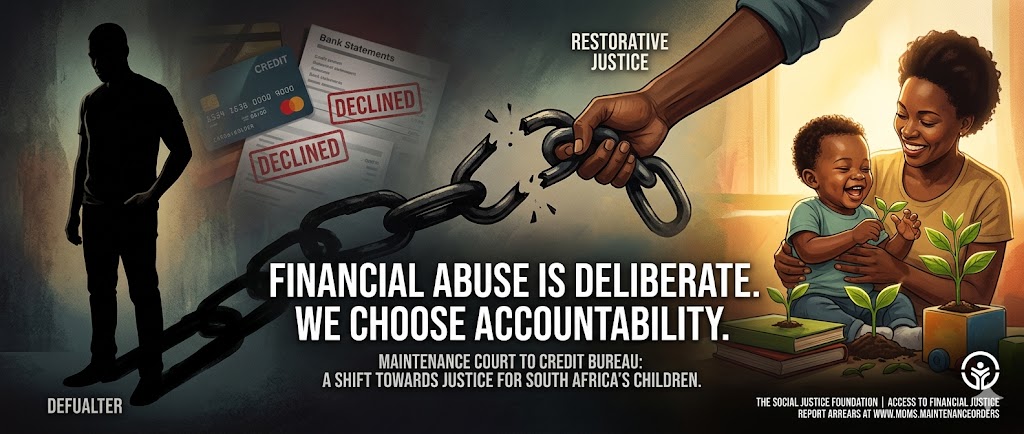
❌ Negative Effect: When You Fall Into Arrears
If your maintenance is in arrears, the impact is serious.
It can lead to:
- Lower affordability
- Higher risk rating
- Higher interest rates
- Declined credit applications
- Civil enforcement actions (like emolument attachment orders, warrant of attachment of property, warrant of attachment of debt i.e. pension)
Arrears are treated similarly to civil judgments. It signals that you are not taking your maintenance obligations seriously, which damages your credit profile.
- If You Are the Parent Who Receives Maintenance (Maintenance Creditor)
Receiving maintenance can improve your financial position.
Because maintenance is a stable, court‑ordered income, it can:
- Increase your disposable income
- Improve your affordability score
- Help you qualify for more credit
- Strengthen your creditworthiness
Credit providers treat maintenance income like any other regular income.
- Why Maintenance Listings Are Allowed
Maintenance obligation listings help to:
- Protect children
- Ensure parents meet their duty of support
- Prevent debtors from taking on new credit while ignoring maintenance
- Support responsible lending
- Give credit providers accurate affordability information
The Constitutional Court has confirmed in cases like Bannatyne v Bannatyne and S v M that parental care includes emotional and financial support. Failing to provide this support violates a child’s constitutional rights.
5. Non‑Payment of Maintenance Is Also Economic Abuse
Under South African law, economic abuse is a form of domestic and gender‑based violence.
When a parent refuses to pay maintenance, it can:
- Deprive the child of essential needs
- Create financial strain for the caregiving parent
- Force the household into debt
- Shift the financial burden to the State (SASSA grants)
- Be used as a tool of control or punishment
Non‑payment of maintenance is not just a financial issue — it is a child‑protection issue and a gender‑justice issue. Non-payment of maintenance is economic abuse.
6. What This Means for You as a Parent
Whether you pay or receive maintenance, your credit profile reflects your financial behaviour.
If you pay maintenance: Paying on time helps you. Falling behind hurts you.
If you receive maintenance: It strengthens your financial position and can help you access more credit.
If maintenance is not paid: It harms your child, the caregiving parent, and can amount to economic abuse.
Maintenance is not just a legal obligation — it is a constitutional duty and a reflection of a parent’s commitment to their child’s wellbeing. Understanding how maintenance affects your credit profile empowers you to make better financial decisions and ensures that children receive the support they deserve.


The Social Justice Foundation launched Conflict Compass, a quarterly digital magazine dedicated to fresh thinking, practical tools, and inspiring voices in the field of conflict resolution. We invite you to be part of the conversation — share your insights, ask a burning question, or submit an article for our upcoming edition. Send your submissions to
Similar Articles
Responsibility Team Writer

Responsibility Team Writer